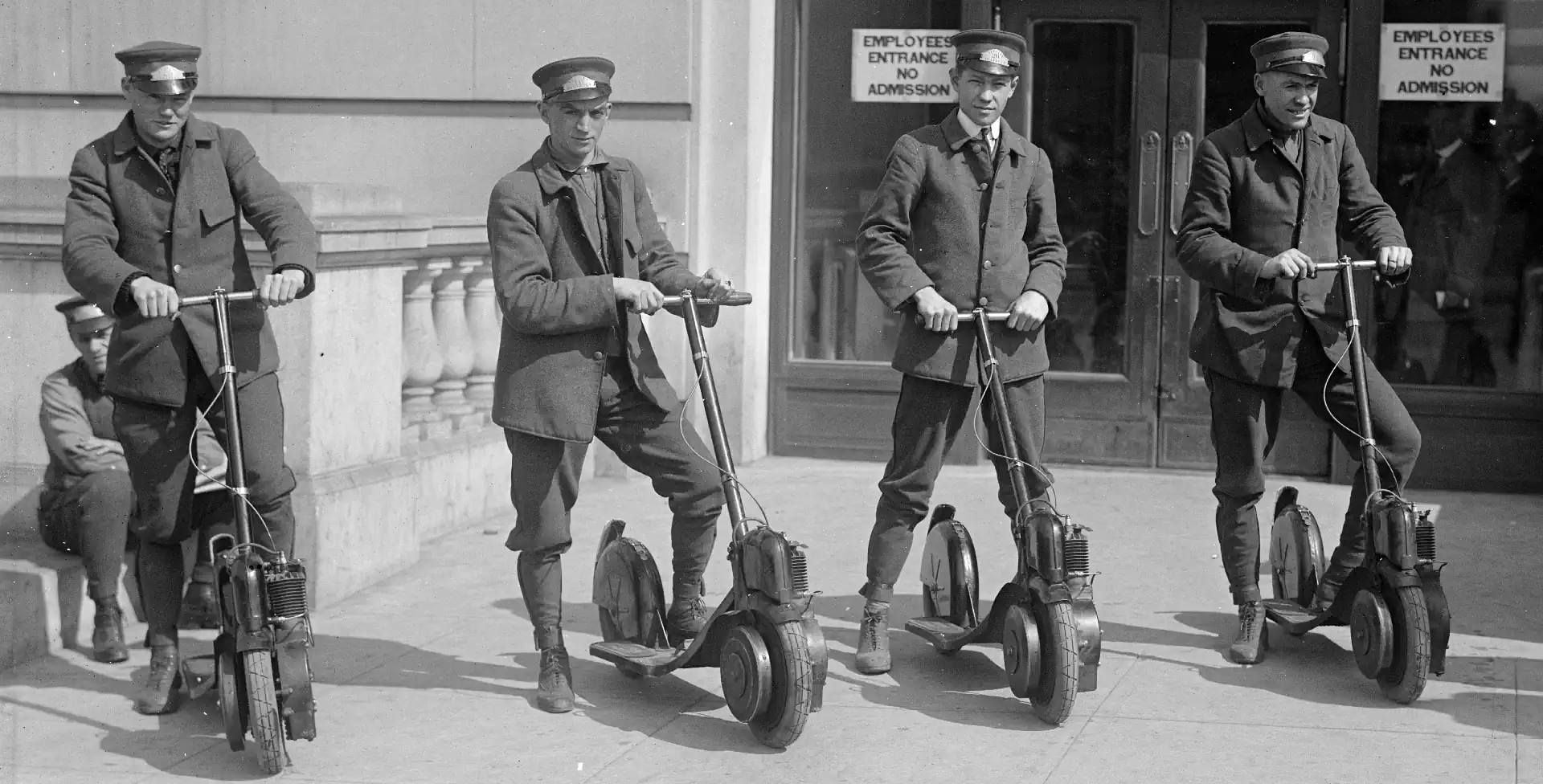
A century before rental companies started flooding our cities with today's electric scooters, a similar design was presented as the future of light, individual transportation. But these scooters packed a real petrol engine!
Kick scooters have been popular with children for over 200 years. In the early 20th century, Arthur Hugo Cecil Gibson, a British inventor living in New York, saw that their light weight and great manoeuvrability would also make them a perfect method of transportation in the hectic roads of the big city. But, of course, having to use one's leg muscles to gain speed wouldn't do for grown-up customers. Battery technology of the day wasn't advanced or affordable enough to make an electric drive feasible, which left only one reasonable option: the scooters had to be fitted with internal combustion engines running on gasoline!
First produced in 1915, the Autoped was powered by a 155 cc air-cooled, one-cylinder four-stroke engine, which could roughly be compared to the engine of a modern push lawn mower. Delivering about 1.5 horsepower, it could reach speeds of 40 km/h (25 mph), which is considerably faster than what most places allow for e-scooters today. Tilting the steering column backwards and forwards controlled the brakes and engine clutch, with a lever controlling the throttle. The pipe of the column even served as an extended fuel tank! The column could be folded down for storage, but at around 43 kg (95 lbs) in weight, they weren't very easily portable.
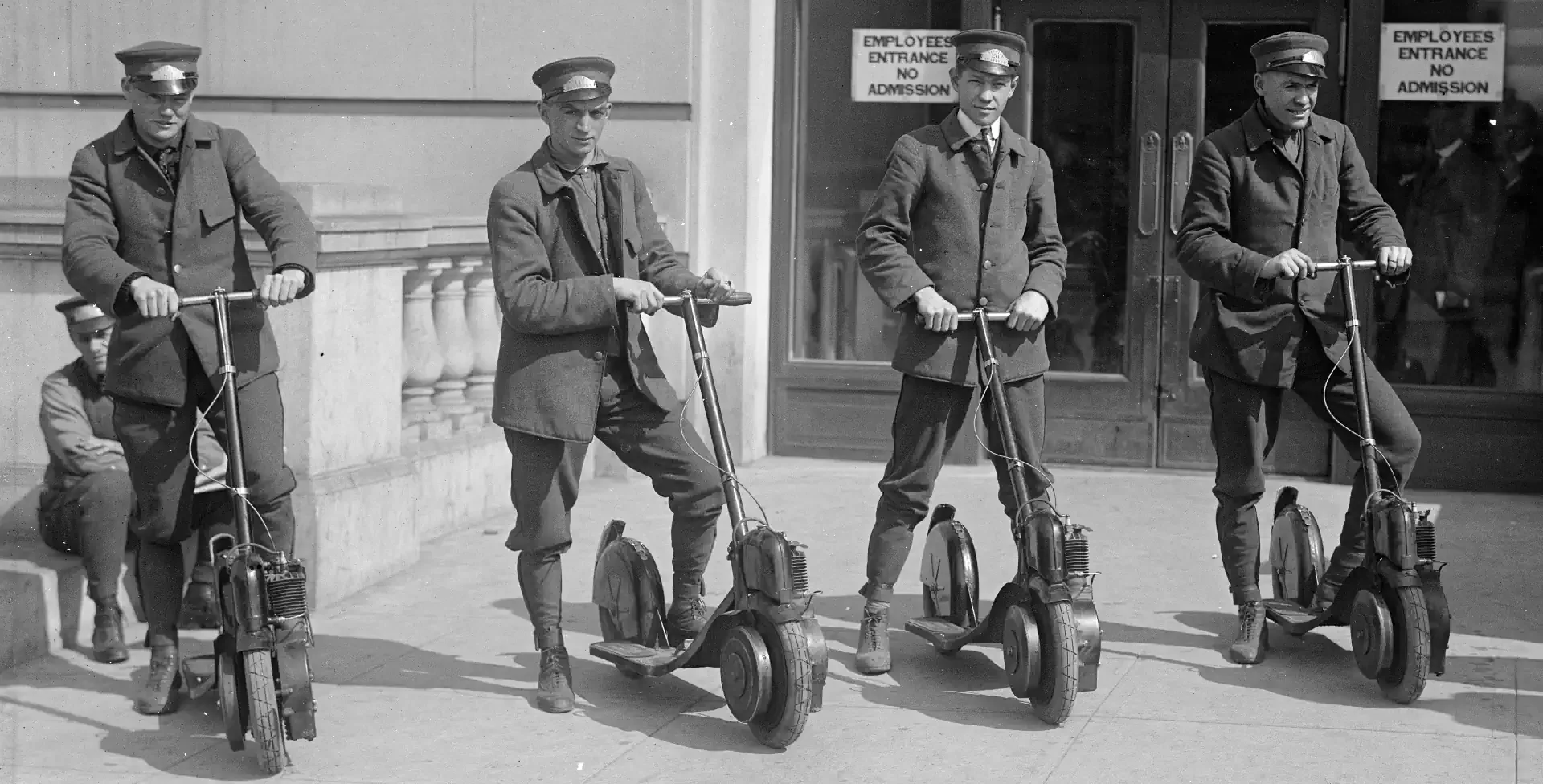
Postmen on Autoped scooters, possibly 1917.
Public Domain. Source: Library of Congress, Prints & Photographs Division, photograph by Harris & Ewing, reproduction number LC-H261-6286-B
The Autoped was advertised as the ideal mode of transportation for city folk. It was said to be perfect for commuting to work, to go shopping, or for older children to ride it to school (traffic wasn't very strictly regulated yet in the 1910s, and initially, it wasn't clear whether operating an Autoped even required a driver's license). But it was also marketed to the professional: for doctors to go on house calls, merchants to do deliveries, salespeople, craftsmen, or messengers, although the Autoped was impractical for many of those tasks as it was difficult to carry bags or packages.
And what about the engine emissions? It's safe to say that despite featuring a four-stroke engine, this 1916 gadget didn't run as cleanly as a modern car or motorcycle. Emission controls didn't exist at the time, and catalytic converters were still a long way off. In addition, the gasoline itself would've been more crude, with added tetraethyl lead to counter its low octane rating, leading to very strongly smelling and highly toxic exhaust fumes.
As you can see from the photographs, the engine and gas tank were mounted to the front of the scooter for stability. No efforts were made to lead the fumes to the rear of the scooter. In fact, when you look closely, you can see the small muffler and exhaust pipe protruding from the bottom of the engine and pointing backwards, blowing the exhaust gas right in the direction of the rider's feet.
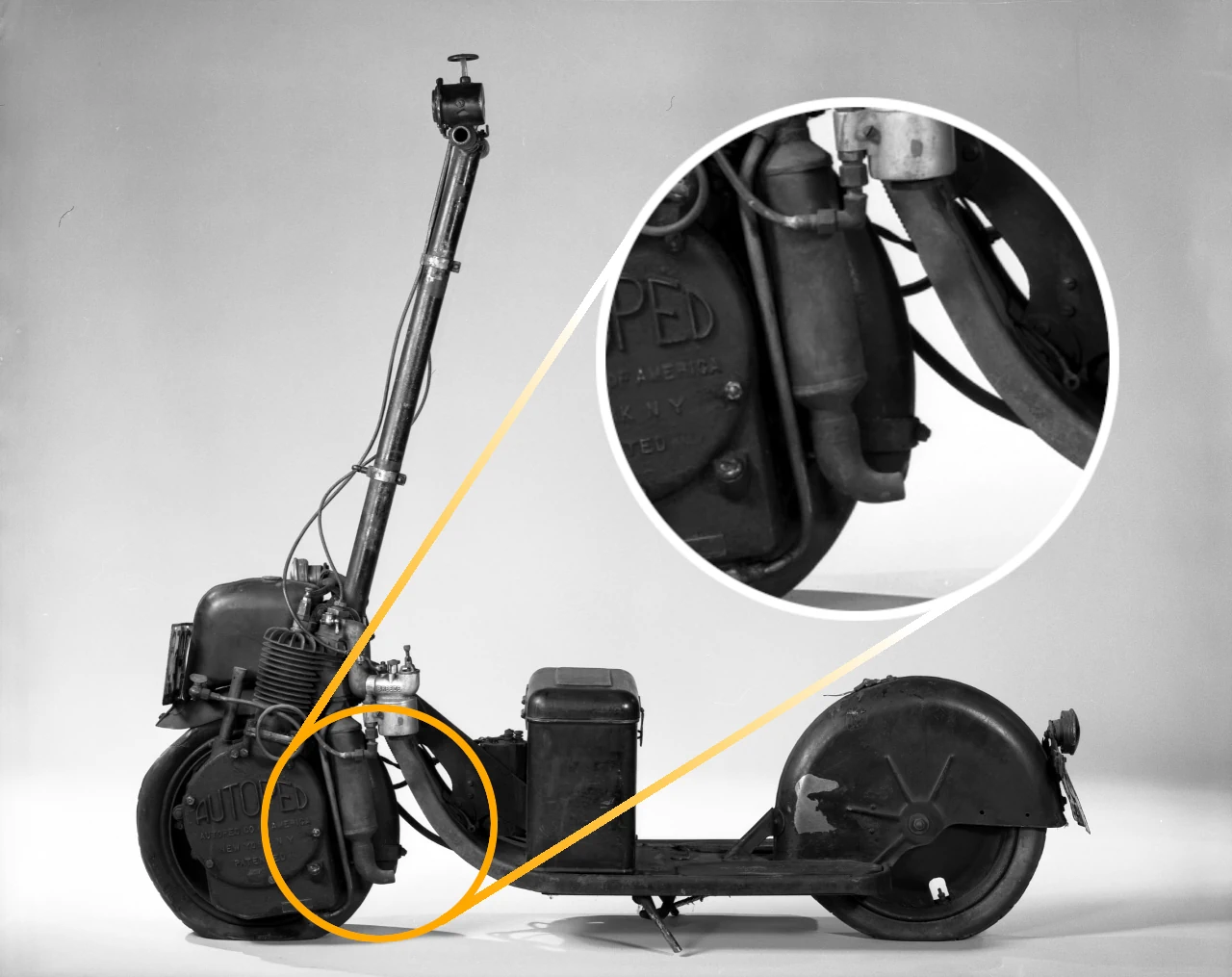
Detail of the Autoped exhaust pipe.
Original photo © National Museum of American History, Smithsonian Institution.
With the slow speeds, stop-and-go movement, and frequent stops of city traffic, one must assume that Autoped users spent most of their ride wrapped in a haze of oily exhaust fumes. Was this perhaps one reason for why the Autoped didn't take the world by storm? Although advertising often showed the Autoped being used by well-dressed, upper-class people, maybe that target audience wasn't keen on arriving at the opera house reeking of oil and gasoline.
Interestingly, another audience that the Autoped was specifically targetting was women. While a woman riding a motorcycle was quite the violation of contemporary gender norms, the light and nimble Autoped was supposed to be an appropriate vehicle for the female population. That it was still seen as a symbol of emancipation is nicely illustrated by a well-known photograph of a famous British suffragist, Lady Florence Norman, posing on her Autoped in London. Incidentally, the photo gives another indication of how badly Autopeds are likely to have polluted the environment, as a pool of oil seems to be forming on the road below the engine.
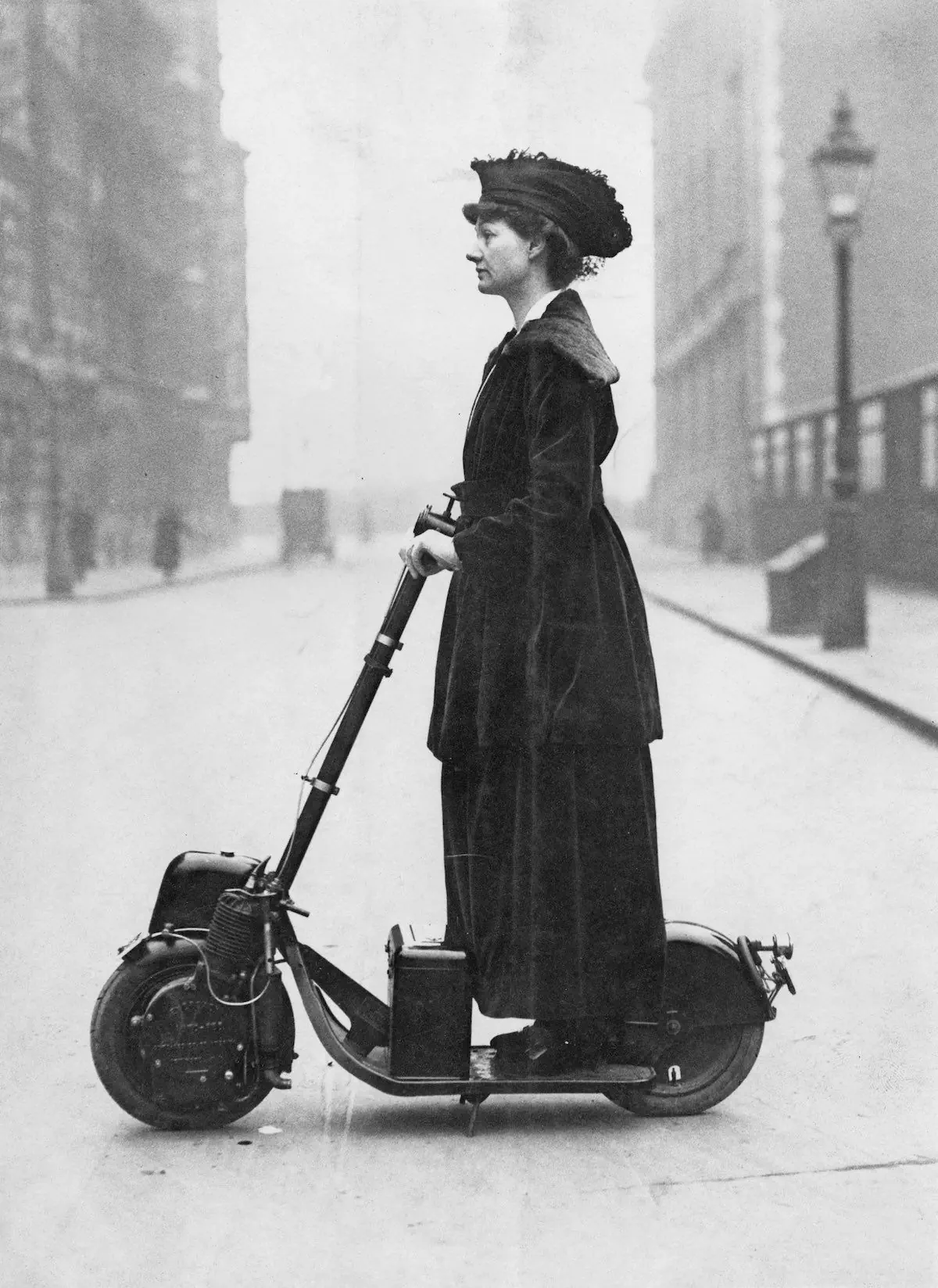
Florence Priscilla, Lady Norman, CBE, JP, on an Autoped in London in 1916.
Public Domain. Source: Wikipedia
Autopeds didn't revolutionize city transportation as was hoped. Production stopped after just six years, with the Autoped Company declaring bankruptcy in 1921. Its inventor had hoped that countless gas-powered kick scooters would redefine what individual transportation in the city looked like, advertising the Autoped as "the motor vehicle of the millions". At around $100, which is close to $3,000 in 2025 terms, an Autoped was considerably cheaper than a motorcycle, and it got good gas mileage (125 mpg, or 1.9 l/100 km). But it was still too expensive for the masses, given its limited usefulness, and was ultimately seen more as a toy for rich folks than a serious method of transportation.
While a commercial failure, the Autoped is remembered as an early example of "petrol culture": our human urge to try adding a combustion engine to absolutely anything we can think of. It also highlights the nonchalance with which the environmental impacts of combustion engines are brushed aside, especially in those days, against the enthusiasm for technological progress. Despite an engine which must have put out a dreadful stench, nothing was thought of fitting the exhaust pipe directly beneath the rider. And even though one should assume that the riders' clothes quickly soaked up a strong smell of gasoline and exhaust fumes, I couldn't find any contemporary sources pointing that out as a drawback.
Of course, this is less prevalent today than it was in the age of the Autoped, where nobody was talking about the environmental impact of burning gasoline yet. But even today, tinkerers are fitting the engines of go-karts or string trimmers to kick scooters for fun, or converting e-scooters to be petrol-powered. You can even find off-the-shelf models, direct descendants of the Autoped, for under $200. In contrast to 1916, however, most countries won't allow them to be used on public roads, confining them to recreational use on private grounds.
Sources
- More photos: 1917 Eveready Autoped (Mecum Auctions, January 9th, 2016)
- More photos: The 1915 Autoped Motorized Scooter (Silodrome Gasoline Culture, August 29th, 2020)
- Tretroller (Wikipedia, accessed December 30th, 2025) (German)
- Autoped (Wikipedia, accessed December 30th, 2025)
- Autoped (ScooterMania, archived July 24th, 2011)
- The Motorized Scooter Boom That Hit a Century Before Dockless Scooters (Smithsonian Magazine, April 18th, 2019)
- (The original) 100 year-old motorscooter up for sale (New Atlas, October 4th, 2016)
- U.S. patent 1,192,514: Self Propelled Vehicle (Google Patents, accessed December 30th, 2025)
Comments