
The processes which formed our original crude oil reserves are still taking place. If we ignore the timeframes, that technically makes it a renewable resource! How much of it could we use for it to still be sustainable? Let's do some back of the napkin math!
Earth's rate of crude oil formation
First, we'll need to get an idea about the speed at which our planet is actually forming crude oil. We'll have to go by some rather rough estimates by geoscientists and ecologists, but it's the best guess we have today.
Geoscientist Robert A. Berner estimated, in papers such as The carbon cycle and carbon dioxide over Phanerozoic time: the role of land plants , that only about 0.1% to 1% of the carbon which plants fix through photosynthesis end up being preserved in deep sediments. Out of this carbon from buried organic matter, ecologist Jeffrey Dukes estimated, in his 2003 article Burning Buried Sunshine: Human Consumption of Ancient Solar Energy , that only 1 out of every 10,750 units will be turned into oil, and only 1% of that gets trapped in deposits we could extract. Generously taking Berner's upper estimate of 1%, we therefore have to divide the planet's estimated net productivity of 104 Petagrams of carbon per year (see also Dukes) by 107,500,000 to arrive at roughly 1 million kilograms per year.
"We're currently consuming mineral oil at a rate which would take 4,5 million Planet Earths to replenish."
With each barrel of crude oil consisting of about 115 kg of carbon, we finally arrive at a rough estimate of 8,400 barrels of crude oil being formed each year. That corresponds to about 350,000 gallons, or 1.3 million litres. Obviously, there are many uncertainties in this calculation. The real number could be considerably higher or lower than that. However, it fits relatively well with another estimation approach, which divides the estimated total of extractable oil reserves that formed up until today (3 trillion barrels) by the rough timeframe over which it formed (300 million years), which would give us a rate of about 10,000 barrels being formed a year – pretty close to our first estimate.
Allocating it to the world population
There are approximately 8.2 billion humans on our planet as of 2025. Dividing the crude oil formation rate from above by this population, we're left with 0.000001 barrels per year for each human being. As the global average life expectancy has approached 73 years, that results in 0.000073 barrels, which is 0.003 gallons, or less than 12 millilitres. As 100 litres of crude oil only result in about 45 litres of gasoline, that amount of oil translates to just a little over 5 millilitres of gasoline.
Our final result is therefore that, if we wanted to use crude oil only at a rate at which the planet could naturally regenerate it, then each and every person on Earth would have a credit of roughly one teaspoon of gasoline over their entire lifetime. How much could you achieve with those few drops of gasoline?

Starting a dirtbike
Let's say you want to ride your 125cc, two-stroke dirtbike for a bit of weekend fun. With the choke pulled in order to be able to cold-start the engine, every kick of the kickstarter uses up about 0.07 millilitres of gasoline. In other words, you'll have used up your lifetime allowance of gasoline after about 70 kicks. And that's before you even manage to actually start the engine! At an idling speed of 1,500 rpm, you could let your engine run for less than a second before your lifetime credit of gasoline was used up.
"Relatively speaking, if Earth had produced all known mineral oil reserves in one year, it would've taken humanity a little over 15 seconds to burn almost half of it up."
How about visiting a motocross race? Now, there's twenty of those 125cc two-stroke dirtbikes, and they're all lined up for a 20-minute moto. While racing, these bikes can well average around 8,000 rpm. Fuel consumption is now about 120 millilitres per minute and rider. That's a total of almost 50 litres of gasoline for the entire race. Those few riders, over the few laps of their 20-minute race, have just burned up the lifetime gasoline allowance of 10,000 people.
A life of motocross riding
Let's consider a lifelong, passionate motocross rider. She starts riding dirtbikes at five years old and practices an average of four hours a week. As she progresses through the classes and changes to bigger bikes, she might have used over 6,600 litres (1,700 gallons) of gasoline by the time she turns 16 years old. (Assumptions: riding a 50cc bike with 1.5 l/h at ages 5–7, a 65cc bike with 2.5 l/h at ages 8–10, and a 85cc bike with 4 l/h at ages 11–15).
While her friends are just about to start an engine for the first time, having finally reached legal driving age, our dirtbike-obsessed teenager would have already burned up enough gasoline for 1.3 million lifetimes.
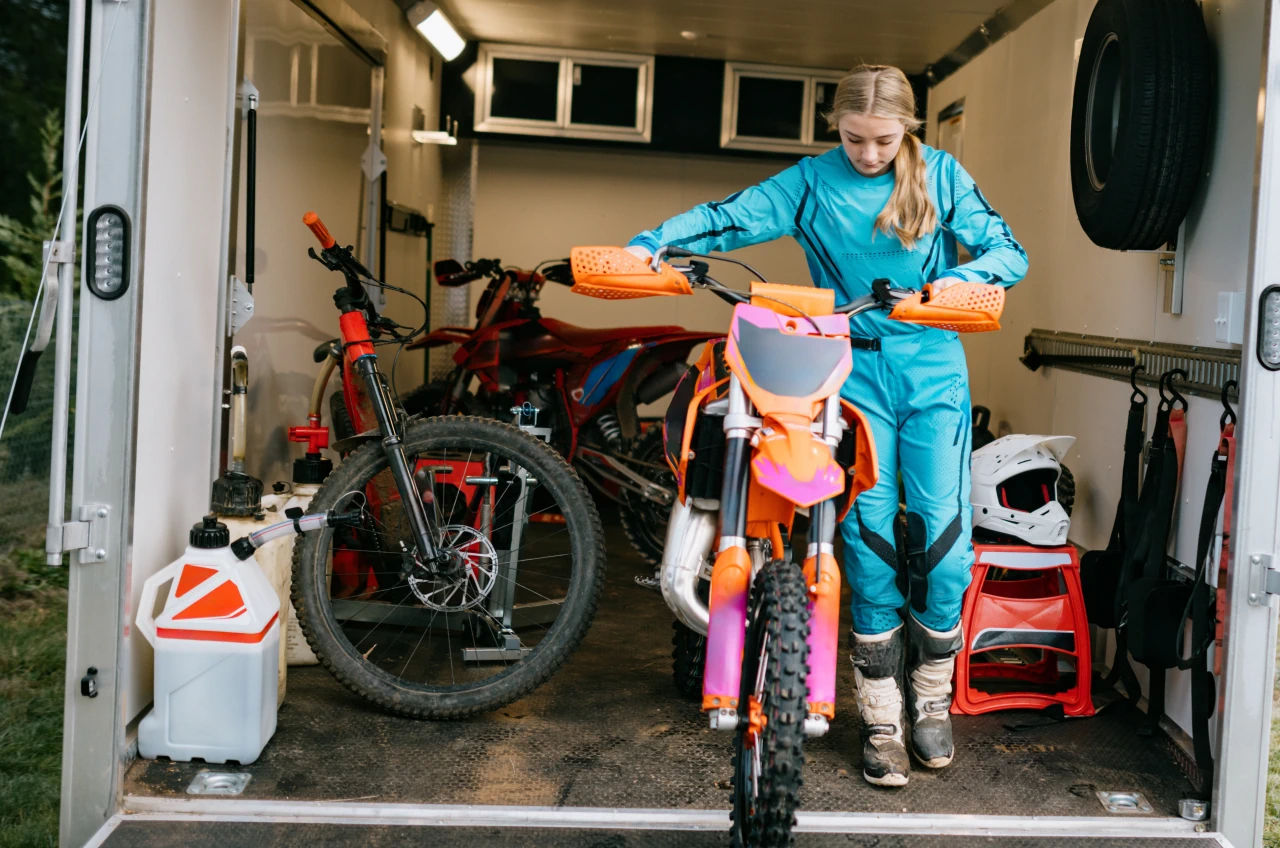
Those who get hooked on riding early tend to never give up on it. If our rider keeps up her 4-hour weekly average until she's 66, with the race consumption from above, this hobby alone would see her burn another 75,000 litres (20,000 gallons) of gasoline. That's the lifetime credit of 15 million people. In other words, Earth could endure about 540 motocross riders (the actual number braaping around on our planet is estimated to be close to 20 million.) That's if there were no other people on the planet besides them, and motocross riding was all these 540 riders used crude oil for. No transportation, no heating, no plastics.
"The average human in Western society uses more than 50 million times as much mineral oil as would be sustainable."
Speaking of plastics: what about her riding gear? Her pants and jersey, boots, gloves, helmet, googles, neck guard, chest and back protector, shin and elbow guards? They're made of polyester, polycarbonate, polystyrene, polypropylene, polyamide – all petroleum-based materials. With the full equipment weighing about 10 kg, and the rule of thumb that it takes about 2.2 litres of crude oil to produce 1 kg of plastics (not accounting for energy production), she's wearing another 22.5 litres of crude oil, or almost 2,000 times her lifetime allotment.
Of course, this number pales in comparison to the amount of petroleum she'd be wasting by burning it up in her engine and turning it into exhaust fumes. But it's interesting to note that if she restricted herself to a sustainable lifetime oil consumption, she wouldn't even have a chance to start riding. Just buying a helmet would already blow her mineral oil credit by orders of magnitude – let alone a dirtbike.
Small machines
A 50cc leaf blower consumes about 15 ml of fuel per minute, so your lifetime gasoline allowance would allow you to blow leaves for about 20 seconds. A typical 50cc scooter would take you a distance of about 250 meters on your lifetime credit. But your scooter's engine is a two-stroke, as well, so you'll have to let it warm up a bit before riding off. Letting it warm up in idle (2 ml/min) for just 30 seconds means you already used up half of that travel distance.
Big machines and big numbers
A large truck (6.5 mpg, 2.7 km/l) could travel about 17 meters – probably not much further than the length of the vehicle. Your allowance would power a passenger jet or a cruise ship (roughly one gallon per second) for less than 2 milliseconds. And what about the military? The American M1 Abrams battle tank consumes about 30 litres of fuel just to start up its turbine engine. That's 6,000 lifetimes of oil credit, just to start a single tank, one time.
The average person living in a developed, Western society is estimated to consume about 1,600 barrels (67,000 gallons, 254,000 litres) of oil over their lifetime. Taking that as a baseline, our oil consumption would be sustainable if no more than 45 people lived on this planet. Looking at it the other way around, current global oil consumption is about 37.5 billion barrels per year. Distributing that among the population of 8.2 billion and everybody's yearly gasoline allowance, we'd need over 10 million planets just to regenerate the oil we use.
How many times your lifetime share of our collective oil reserves have you used up so far? Today? In the last hour?

Comments